Skip to content

Litepaper, Deck 59

Deck 59

Cypherpunk. Arcade. Community.

A shared operating system that is also a marketplace. You don't install it. You enter it.

Deck 59 is a product built by Modulo 59, an independent digital studio. It is not the studio itself.

01 / The short version

Open a browser. You land on a desktop.

It looks like a computer from the era before computers started spying on you. Winamp is playing. There's a start menu, icons, windows you can drag around. But this desktop is not yours alone. Everyone who enters Deck 59 lands in the same room. The person three icons over is a real human, right now, and you can talk to them, trade with them, and hand them software without either of you downloading a thing.

That's the whole idea. Everything else is detail.
02 / Why build this

Finding the right people is broken.

You cold email. You slide into DMs. You hope someone answers. You get filtered by an algorithm that would rather show you an ad. The tools we use to coordinate were built by companies that make money when you stay lost and scrolling.

The early internet had a different shape. People ran their own corners. You went somewhere and other people were already there. The cypherpunks talked about the agora: an open marketplace where people meet and trade directly, no landlord taking a cut, no permission required. That idea got buried under app stores and login walls.

Deck 59 digs it back up.

03 / What it is

A desktop that lives in your browser and belongs to a community instead of a corporation.

You don't install apps on your machine. Apps live in the system. They show up on the desktop as icons, and they can be added, removed, requested, and passed between people. Someone builds a tool. You see it, you want it, you ask for it in chat, and it lands on your desktop. No gatekeeper deciding what's allowed. No thirty percent tax on every exchange.

The social layer is not bolted on the side. It is the point. IRC channels for real conversation. Profile pages in the spirit of the old web, where your corner looks like you and not like a template. You are not a row in someone's database. You are a person with a desk in a shared building.

04 / The BASE

The foundation never changes.

Everyone customizes their own desktop. Move the icons, swap the apps, make it yours. But there is a foundation that never changes, identical for every person who enters. We call it the BASE, and we build it. Three things always ship with it:

The Arcade

Playable, always on. Games are how people gather without needing a reason. The arcade is the front porch of the whole thing.

Project B59

A living archive. Culture, history, the record. The part of the system built to outlast the people who made it.

Buckazoids

The community and the money. More on that below.

Those three are the constitution of Deck 59. Everything you build on top is yours. The floor you stand on is ours, and it's the same floor for everyone. That shared floor is what turns a pile of apps into a place.

05 / It starts with a coin

Buckazoids saw it first.

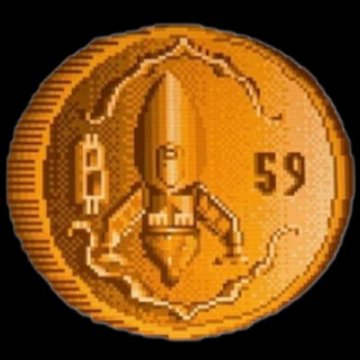
Buckazoids came from Space Quest, the Sierra series that began in the mid-1980s: a gold coin stamped with a bold 59, the currency of an entire galaxy. Long before Bitcoin, before the word cryptocurrency existed, someone imagined money that moved freely across open space, answering to no planet, no nation, no bank.

That is the same future the cypherpunks spent decades building toward. The same future we live in now.

We didn't mint it. Buckazoids already lived on Solana, and when the original developer stepped away, the community took it over and kept it alive. No single founder owns it, and that is the point. Buckazoids is carried by the same thing that carries Deck 59: the people who showed up for it.

Pixel-art Buckazoid coin with a rocket and the number 59.

06 / How trade works

This is the agora, rebuilt as software.

You want something. Someone has it. On most of the modern internet, connecting those two facts takes a middleman, a marketplace fee, and a terms-of-service update nobody reads.

Here it's direct. You chat in IRC. You agree. The app gets delivered through the system to their desktop. Payment settles in crypto. The system does not stand between two humans and take a cut for the privilege of letting them agree on something.

People come together, they trade, they leave when they want to. The marketplace is not a store we run. It's what happens when you put people in the same room and get out of the way.

07 / Money

Crypto-native and chain-agnostic.

Pay in what you hold. We are not here to force one coin down your throat. Buckazoids is the coin this community carries, and the door stays open to whatever you bring.

08 / Two doors

One door is loud. One door is quiet and built to survive.

Deck 59 opens on two protocols.

The first is HTTPS, the web you already know, where the full desktop lives with all its noise and color.

The second is Gemini. Not the company, not the chatbot. The Gemini protocol is a small, deliberate way of serving content: text-first, encrypted, no tracking, no scripts, nearly impossible to bloat and hard to kill. The archive, the feeds, the record, and this document itself can live there in plain, durable form.

Signal persists on both.

09 / Where this comes from

The parts are known. The synthesis is ours.

We are not pretending we invented every piece. Browser desktops exist. Decentralized personal servers exist. Retro web nostalgia is its own genre now.

What does not exist is this combination: a cypherpunk arcade with real money in it, a social agora where trade is the native act, a fixed cultural base that every user shares, and a project that treats old games and the history of money as the same story. The parts are known. The synthesis is ours, and so is the culture around it.

10 / What we're not saying yet

This is a vision, and that's on purpose.

We're painting the room, not publishing the blueprints, and we'd rather move deliberately than narrate every mechanic in public.

The hard parts are being worked, not hand-waved: how apps run under the hood, and an identity model where a wallet is the obvious key to the building. We have a direction on both. We'll show it when it's ready to be shown, and not a moment before.

No roadmap theater, no promises we can't keep. What we have is a clear picture of the room we're building and the people we want in it. If that room sounds like somewhere you'd want a desk, you're who this is for.